
BLOG::19 Oct 2026
Where Security Showed Up at OCP Global Summit 2026
by Carmen Young
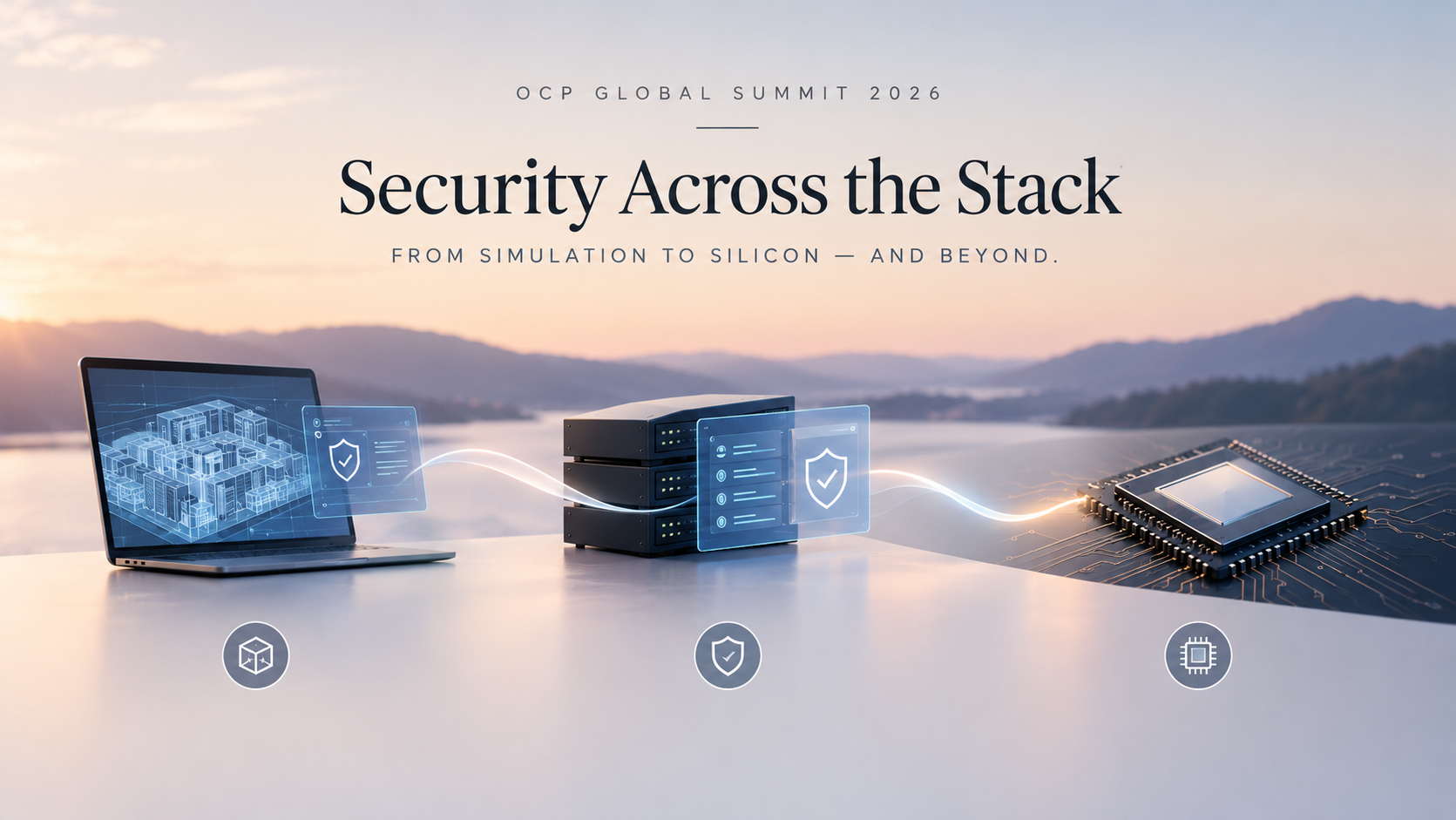
The 2026 OCP Global Summit ran from October 12 to 15 in San Jose, and the theme was "Scaling Innovation for the AI Era." The security track had plenty to dig into, but the more interesting story was where security showed up outside that track.
The first place was validation. NVIDIA and Keysight used their session on logical digital twins to argue that AI factory designs should be tested in software before they are built in hardware. Security was one of the areas the digital twin is meant to emulate. Alibaba and Google made a related point in their formal methods work on SONiC. They treated models as executable specifications, generated tests from them, and kept that work in a public repository. The message was practical. Find the security gaps while they are still cheap to fix.
The management track made a quieter point, but it was still an important one. Celestica's GraphQL proposal for OpenBMC metrics was presented as a way to reduce noisy telemetry and make vendor onboarding easier. The security angle matters too. By putting a proxy layer between clients and baseboard management controllers, access becomes concentrated and controlled. Intel and Dell showed a similar idea from another angle with their work on remote manageability for IT and OT. By building on Redfish profiles contributed publicly to OCP, they are supporting a standardized management interface that is easier to audit than a vendor-specific one.
Thursday's security track brought the story down to the hardware. Infineon talked about Trusted Platform Modules (TPM) using Security Protocol and Data Model (SPDM), with post-quantum support on the roadmap. Think of it as a secure handshake for hardware: prove who you are, show your certificates, share measurements, then establish a protected channel.
Samsung paired OCP L.O.C.K. with FIPS 140-3 validation to protect storage encryption keys. LowRISC and Google presented open-source design verification infrastructure for Caliptra, so integrators can verify the root of trust instead of assuming it. Intel added runtime authorization to out-of-band firmware updates so only owner-signed images can activate. Marvell focused on key distribution between hardware blocks inside an SoC, and Astera Labs extended the idea to the network layer, moving security beyond individual links and into entire scale-up pods.
That was the bigger picture at OCP this year. Security started in simulation, where problems can be found before hardware exists. It moved through the management plane, where open and standardized interfaces make behavior easier to see. It ended in silicon, where trust is rooted, attested, and now being prepared for post-quantum cryptography. Different companies are doing the work in the open, and they are doing it in the same venues. That was the clearest signal of where infrastructure security is heading.